
Can You Lose a Job Offer by Negotiating Salary?
Can negotiating salary cost you the offer? When employers rescind, how to negotiate safely, scripts to use and what to do if an offer is withdrawn.

Yes, you can lose a job offer by negotiating salary, but it is rare when you negotiate respectfully. Employers usually expect a counteroffer, and offers are more often withdrawn because of how a candidate negotiates, such as ultimatums, a hostile tone or demands far above budget, than because the candidate asked at all. This guide covers when employers rescind offers, how to negotiate safely, word-for-word scripts and what to do if an offer is withdrawn or you decide to turn it down.
Key takeaways
- Negotiating a salary offer is normal, and a polite, specific, researched request rarely costs you the offer.
- Offers are usually lost because of how people negotiate: ultimatums, hostile tone, unrealistic numbers or long delays.
- Most U.S. employment is at will, so an employer can generally withdraw an offer before you start. Get the final offer in writing before you resign elsewhere.
- If the numbers still do not work, decline promptly and politely, and leave the door open for future roles.
Can you lose a job offer by negotiating salary?
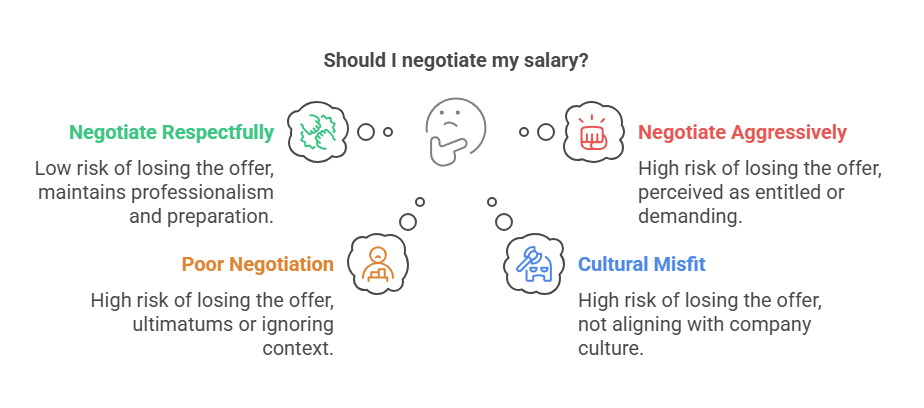
Technically, yes. In practice, a respectful negotiation almost never ends an offer on its own. What changes the outcome is the way you ask. The table below shows which moves keep the risk low and which raise it.
| Lower-risk moves | Higher-risk moves |
|---|---|
| Thanking the employer before discussing pay | Opening with “that number is insulting” |
| Asking for one specific figure or a narrow range | Asking for a figure far above the role’s budget with no reason |
| Backing your request with market data and results | Saying you “need” more without context |
| Asking whether there is flexibility | Issuing an ultimatum (“match it or I walk”) |
| Replying within a day or two | Going silent for a week, then changing your demands |
| Considering bonus, start date or remote work | Refusing to discuss anything except base salary |
Preparation lowers the risk further. Check what the role pays in your location with the AI Salary Copilot, and rehearse the conversation out loud with the AI Interview Simulator so your tone stays calm under pressure. The strongest leverage, though, is having other options: if AI automated job application keeps applications going out while you interview, a single offer feels less like your only chance, and you negotiate with less anxiety.
Why employers rescind job offers after negotiation
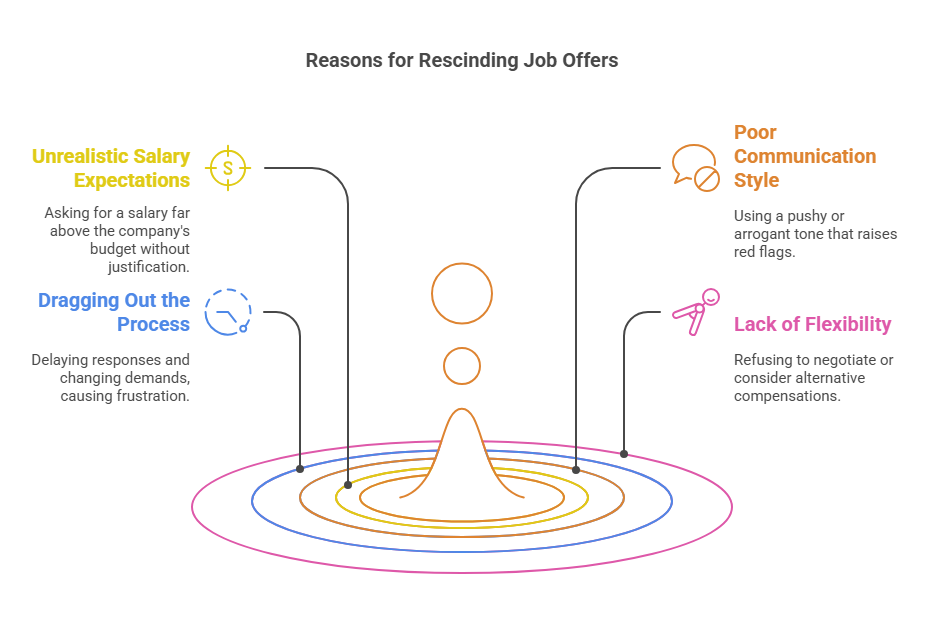
When an offer is withdrawn after a counteroffer, it is usually for one of these reasons.
Unrealistic numbers
Asking for far more than the budget for the role, without explaining why, can signal that you and the employer see the job differently. If your research supports a big jump, show it, and ask whether a higher level or title is possible.
Tone
Pushy, defensive or dismissive language makes hiring managers wonder how you will treat colleagues. Negotiation is the first time they see how you handle a disagreement.
Delays and moving goalposts
Taking a week to reply, then adding new demands after the employer moves, makes it look as if you are not committed. Make your requests in one round.
Inflexibility
Refusing to discuss anything but base salary leaves the employer no room. Bonuses, start dates, vacation, remote days and training budgets are often easier for them to change.
Reasons that have nothing to do with you
Budget freezes, reorganizations, internal candidates and failed background checks also end offers. If an offer is withdrawn right after you negotiate, the timing may be a coincidence.
Why most employers expect you to negotiate
Recruiters often build some room into a first offer, and a calm counteroffer is a routine part of hiring. Negotiation experts also advise looking beyond the base figure. The Program on Negotiation at Harvard Law School warns that “negotiating exclusively, or even primarily, on salary is usually a mistake” and recommends negotiating the whole package (Harvard PON). That approach also lowers your risk, because it gives the employer more ways to say yes.
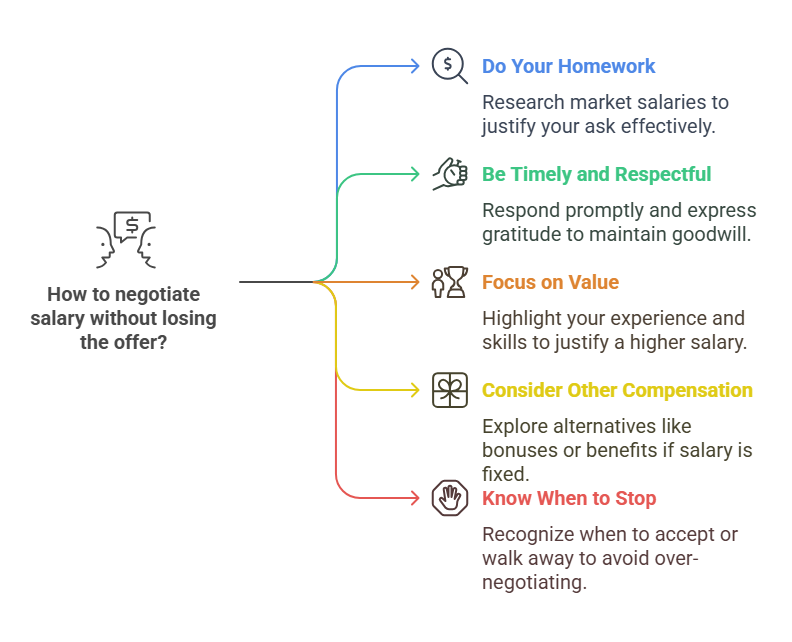
How to negotiate salary without losing the offer
- Wait for the offer, then say thank you. Start by confirming you are excited about the role. Gratitude sets a cooperative tone.
- Research the market rate. Use the Bureau of Labor Statistics Occupational Outlook Handbook, salary sites and recent postings for similar roles in your area. Know your target, your minimum and why.
- Ask once, with a number. A specific figure or a narrow range anchored to your experience and results is easier to approve than “Can you do better?”
- Listen more than you talk. Ask about the budget, how raises work and what flexibility exists. The 70/30 rule of thumb, listening 70% of the time, helps you find the option that works for both sides.
- Negotiate the whole package. If base pay is capped, ask about a signing bonus, an earlier review, extra vacation, remote days or a professional development budget.
- Know when to stop, and get it in writing. When the employer gives its best offer, accept or decline. Do not resign from your current job until you have the final offer in writing.
Salary negotiation scripts you can copy
Replace the brackets with your details. Keep each message short.
Scenario 1: counteroffer by email
Subject: [Job title] offer: thank you and a question on compensation
Hi [Name],
Thank you for the offer. I’m excited about the [job title] role and the work your team is doing on [project or goal].
Before I accept, I’d like to discuss the base salary. Based on my [number] years of experience in [area], results such as [one measurable result] and current market data for this role in [city], I was hoping for [figure]. Is there flexibility to get closer to that number?
I’m confident we can find something that works, and I’m looking forward to joining the team.
Best, [Your name]
Scenario 2: the recruiter calls with the offer
“Thank you, I’m really glad to hear that, and I’m excited about the role. Could you send the full offer in writing so I can review everything? … Having looked at it, the one area I’d like to discuss is the base salary. Based on the scope of the role and what similar positions pay in [city], I was expecting something closer to [figure]. Is there any room to move?”
Then stop talking and listen. If the recruiter needs to check with the hiring manager, agree on when you will hear back.
Scenario 3: the salary is fixed
“I understand the base salary is set. Would it be possible to look at other parts of the package, such as a [signing bonus / review at six months / extra vacation days / remote days]? That would make it much easier for me to say yes.”
If you have a competing offer, mention it factually and only if it is real: “I have another offer at [figure]. This role is my first choice, so I wanted to ask whether you can get closer to that.”
What to do if a job offer is rescinded
If an employer withdraws an offer, work through this checklist:
- Ask for the reason in writing, politely. Sometimes the cause is a budget change, not your negotiation.
- Ask whether the original offer still stands. Some employers will reinstate it if you accept the first terms.
- Do not resign until you have a written offer. If you already resigned, ask your current employer whether you can stay.
- Check for illegal reasons. An offer cannot be withdrawn because of a protected characteristic such as race, sex, age or disability. The U.S. Equal Employment Opportunity Commission explains how to file a charge.
- Get advice if you relied on the offer. If you resigned or relocated because of it, a short consultation with an employment lawyer can clarify your options.
- Restart your search quickly. Our guide on how to find a job faster covers the fastest ways to rebuild a pipeline.
How to turn down a job offer gracefully
Sometimes the right outcome is to say no, and declining because of salary is common and acceptable. Do it in a way that keeps the relationship intact:
- Reply promptly, ideally within a day or two of deciding, so the employer can move to other candidates.
- Start with thanks and mention something specific you appreciated about the team or process.
- State your decision clearly. Vague wording can leave the employer unsure whether you are still negotiating.
- Give a short reason if you want to. “The compensation doesn’t meet my needs” is enough.
- Leave the door open. Recruiters remember candidates who decline well.
Subject: [Job title] offer
Hi [Name],
Thank you again for offering me the [job title] role and for the time your team spent with me. After careful thought, I’ve decided to decline. The compensation doesn’t meet my current needs, and I didn’t want to accept an offer I couldn’t commit to fully.
I enjoyed meeting the team and hope our paths cross again. If a more senior role opens up, I would be glad to hear from you.
Best regards, [Your name]
Email is fine in most cases. If you had several interviews with senior leaders, a short phone call followed by a confirming email is more personal.
Prepare before the offer arrives
The best negotiations start earlier in the process. Strong interview answers build the leverage you use later, so practise common application-based questions and employer-specific guides such as Walmart interview questions. For more career guides, browse the job search category.
Before your next offer conversation, check what the role pays with the AI Salary Copilot and rehearse your counteroffer in the AI Interview Simulator. Both come with JobsAICopilot, which also applies to matching jobs for you so you are never relying on a single offer. Compare plans on the pricing page.
Job Search
Frequently Asked Questions
Still have a question?
Write to contact@jobsaicopilot.com or visit our contact page.
What happens when you counter a job offer?
Usually the employer considers your request and replies within a few days in one of three ways: it meets your number, meets you partway or says the offer is final. Occasionally it withdraws the offer, most often after an ultimatum or an unrealistic demand. Whatever the reply, you can then accept, negotiate briefly on other terms or decline.
Will negotiating salary backfire?
Rarely, if you negotiate professionally. Employers usually expect a counteroffer and either meet you partway or tell you the offer is final. Negotiation tends to backfire when the request is far above the budget for the role, comes with an ultimatum, drags on for weeks or is delivered in a hostile tone. A polite, data-backed ask carries little risk.
Can a job rescind an offer if you negotiate?
Usually yes, legally. Most U.S. employment is "at will," so an employer can generally withdraw an offer before you start for any lawful reason, though it is uncommon after a respectful negotiation. It cannot withdraw an offer for an illegal reason, such as discrimination. If you resigned from another job because of the offer, consider speaking to an employment lawyer.
What is the 70/30 rule in negotiation?
The 70/30 rule is a rule of thumb that says you should listen about 70% of the time and talk about 30% of the time in a negotiation. In salary talks, that means asking open questions about budget, priorities and flexibility, then using what you learn to frame a request the employer can say yes to.
Is it okay to negotiate a salary offer?
Yes. Negotiating is a normal part of hiring, and many employers leave room for a counteroffer. Wait until you have an offer, research the market rate for the role and location, and ask once with a specific figure or a narrow range. If the employer says the salary is final, you can still ask about other parts of the package.
Is it okay to decline a job offer because of salary?
Yes. Pay is one of the most common reasons to turn down an offer. Before declining, ask whether there is any flexibility on salary or other parts of the package. If there is not, decline promptly and politely, thank the employer, say that the compensation does not meet your needs and leave the door open for future roles.


