
How Many Jobs Should You Apply to a Day? Realistic Targets for 2026
How many jobs should you apply to a day? A realistic daily target for quality applications, plus how automation changes the math.

Most job seekers should apply to 2 to 5 well-matched jobs a day, or roughly 10 to 25 a week, when they write each application by hand. Indeed’s Career Guide suggests two or three a day (10 to 15 a week); go higher only if your field has many openings and every application stays tailored. With an AI job application bot filling in the forms, you can raise that number without lowering quality, as long as each role still fits.
The right number depends on your time, your field and your results. Below are targets by situation, what 2026 data says about application volume, and how to hit your number without burning out.
Key takeaways
- Aim for 2 to 5 tailored applications a day (10 to 25 a week) if you search full time, and 1 to 2 a day if you are employed.
- Quality beats quantity: in Huntr’s Q1 2026 data, people who sent 11 to 20 applications interviewed at 9.25% per application, against 2.58% for those who sent 100 or more.
- Apply to roles where you meet most of the core requirements, and to no more than two or three roles per company.
- Measure replies weekly; if 30 or more tailored applications bring no interviews, fix your targeting before adding volume.
- Automation changes the math by taking over searching and form filling, not the decision about which roles fit.

How many jobs to apply for per day, by situation
| Your situation | Daily target | Weekly target | Focus |
|---|---|---|---|
| Unemployed, searching full time | 3-5 | 15-25 | Tailored applications plus daily networking |
| Employed, searching on the side | 1-2 | 5-10 | Only strong matches; protect your time |
| Changing careers | 1-3 | 5-15 | Referrals and informational chats over volume |
| Entry-level or high-turnover fields (retail, hospitality, customer service) | 5-10 | 25-50 | Speed and availability; short applications |
| Senior, specialist or executive roles | 1-2 | 3-10 | Research, networking and recruiters |
These are starting points, not quotas. Indeed’s Career Guide recommends two or three job applications per day as a baseline, and the ranges above adjust it for the time you have and the number of openings in your field.
To go beyond these numbers without lowering quality, let software take the repetitive parts. Automated job search checks company career pages for new matches every day, AI automated job application tailors and submits applications within your filters, and an AI job tracker records every submission so nothing is sent twice.
What the data says about application volume
The labor market sets the backdrop. U.S. employers had 7.1 million job openings and made 5.2 million hires in August 2026, according to the BLS Job Openings and Labor Turnover Survey. Searches still take time: the median unemployed person had been looking for 12.1 weeks in September 2026 and the average for 25.4 weeks (BLS Table A-12, not seasonally adjusted).
Within that market, more applications do not automatically mean more interviews. Huntr, a job-tracking app, analyzed about 140,000 applications its users logged in Q1 2026 and found that interview rates per application fell as total volume rose.
| Applications sent in Q1 2026 | Interviews per application |
|---|---|
| 11 to 20 | 9.25% |
| 21 to 50 | 6.96% |
| 51 to 100 | 4.65% |
| 100 or more | 2.58% |
Source: Huntr Q1 2026 Job Search Trends Report, users who sent at least 11 applications in the quarter.
There are caveats. People who send hundreds of applications may be in harder fields or situations, so the data shows a pattern rather than proof that volume causes lower rates.
Two other findings point the same way, though. Tailored resumes were interviewed at about twice the rate of untailored ones (4.23% vs 2.07%), and applying eight or more times at one company cut the rate to 1.91%, against 6.07% for a single application.
How many applications it takes to get a job
Volume still matters, because most searches need more than a handful of applications. Among Huntr users who landed a first offer between April 2025 and March 2026 after logging at least 11 applications, the spread looked like this.
| Applications before the first offer | Share of users |
|---|---|
| 11 to 20 | 31.3% |
| 21 to 30 | 17.0% |
| 31 to 50 | 16.8% |
| 51 to 100 | 20.4% |
| More than 100 | 14.5% |
Nearly half needed 30 applications or fewer, while about a third needed more than 50. At three tailored applications a day, 50 applications take a little over three working weeks. Add the time for interviews and decisions, and it is easy to see how searches reach the BLS median of about 12 weeks.
The practical lesson: plan for a long search, but make each application count. Raising your interview rate per application is usually the cheaper way to shorten the timeline, because it does not cost you extra hours.
A sample week at three applications a day
Here is what a sustainable full-time week can look like. Adjust the numbers using the targets by situation earlier in this guide.
| Day | Applications | Other tasks |
|---|---|---|
| Monday | 3 tailored | Update alerts and shortlist roles for the week |
| Tuesday | 3 tailored | Two networking messages |
| Wednesday | 3 tailored | Follow up on applications from the previous week |
| Thursday | 3 tailored | One mock interview or practice session |
| Friday | 3 tailored | Weekly review of replies by title and channel |
| Weekend | 0-2 | Rest, or prepare for interviews already booked |
That adds up to 15 to 17 applications a week, plus the networking and follow-ups that often lead to the first interview.
How long one good application takes
A daily target only works if it fits your hours. These are rough time estimates for a careful application, by hand and with AI help.
| Task | By hand | With AI assistance |
|---|---|---|
| Read the posting and confirm fit | 5-10 min | About 5 min |
| Tailor the resume summary and top bullets | 15-30 min | 5-10 min to review a draft |
| Write or adapt a cover letter | 15-20 min | About 5 min to edit a draft |
| Fill in forms and screening questions | 10-20 min | Near zero with automation; review the answers |
| Log it in your tracker | 2-5 min | Automatic |
At roughly 45 to 85 minutes each by hand, three to five applications fill a three- to five-hour block. That is why 2 to 5 a day is the realistic ceiling for most people writing every application themselves.
Leave room for networking and interview preparation, too. They often move a search forward faster than one more application.
Factors that change your number
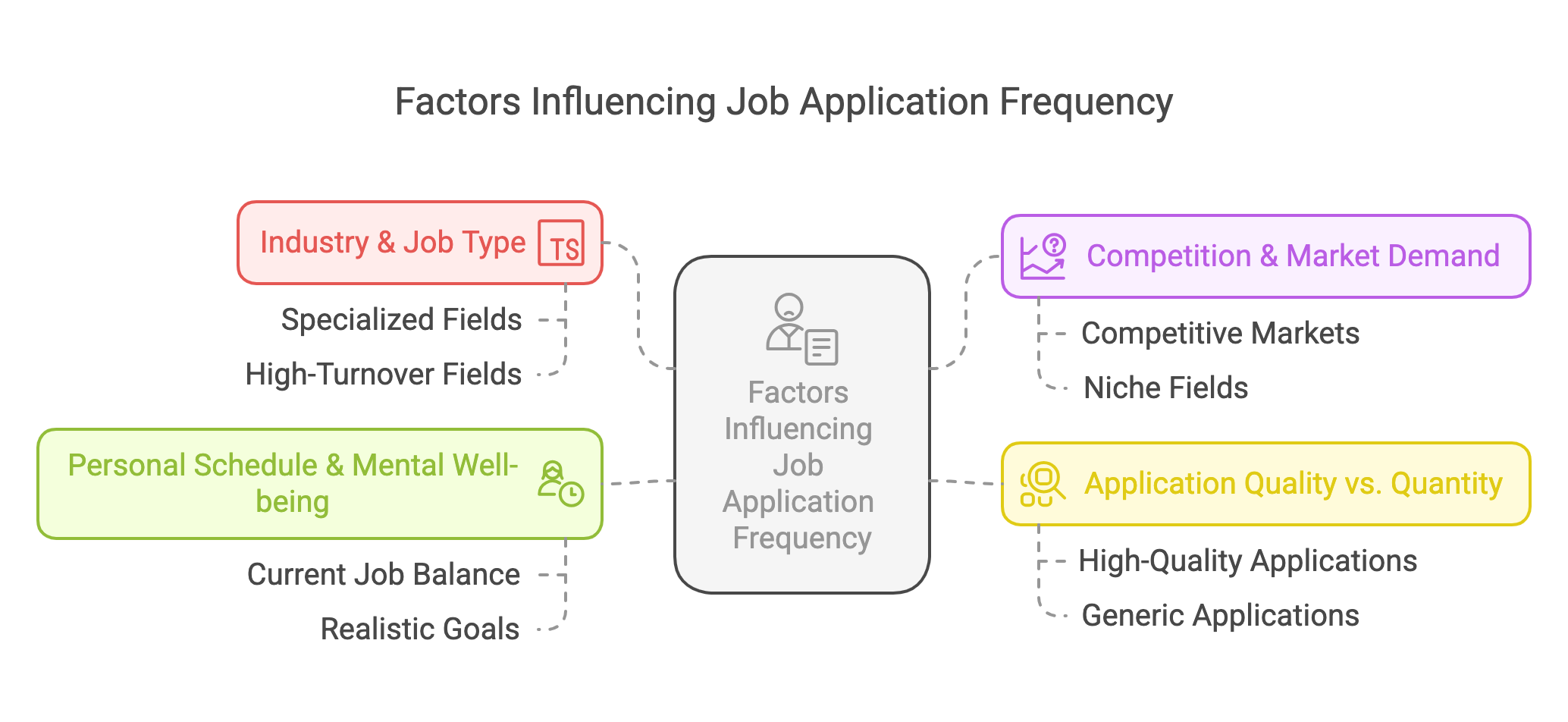
Your industry and job type
Specialized fields such as engineering, finance or healthcare reward fewer, highly tailored applications. High-turnover fields such as retail or customer service reward speed and more applications, because roles fill within days.
Competition and the number of openings
If your title has many postings in your area, you can apply more often without lowering fit. In a niche field with few openings, a lower number is normal, so spend the extra time on referrals and direct outreach.
Your fit with each role
Apply when you meet most of the core requirements, not every line on the posting. Roles where you meet only a few requirements rarely lead to interviews and drag your reply rate down.
Where you apply
The channel changes how far each application goes. In Huntr’s trailing twelve-month data, applications found through Google led to interviews 7.12% of the time, against 2.94% for LinkedIn postings, and Huntr notes that Google often sends applicants to the employer’s own application form.
If most of your applications go through one crowded board, shifting some of them to company career pages can raise your interview rate without raising your daily number.
Your schedule and energy
A target you can keep for eight weeks beats one you abandon after five days. If you are searching while employed, studying or caring for family, one or two strong applications a day is enough.
How to hit your daily target without burning out
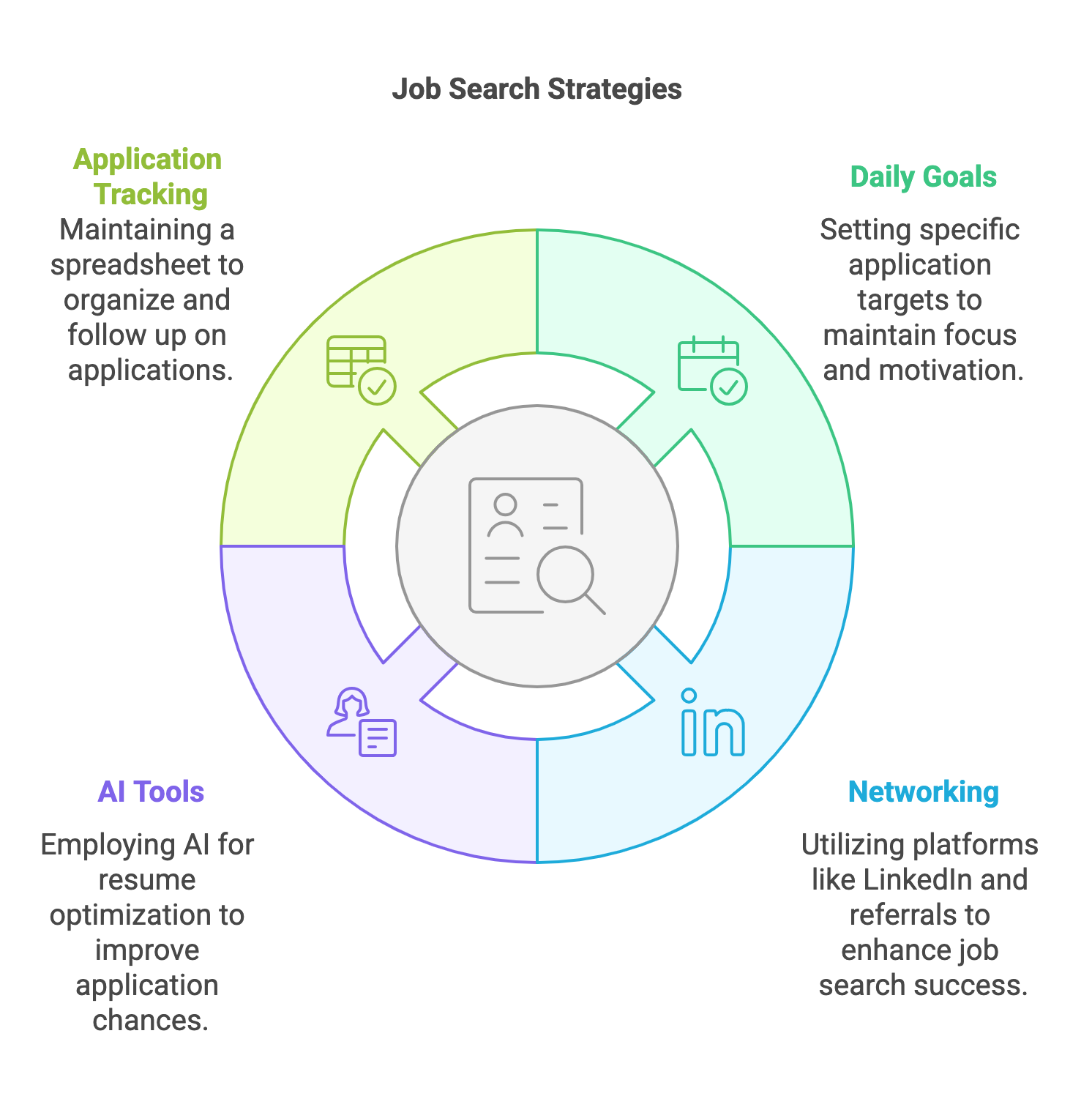
- Batch your work. Shortlist roles in the morning, tailor in one block and submit in another.
- Reuse what works. Keep two or three resume versions for your main job titles and a library of tested answers to common screening questions.
- Set a floor, not just a ceiling. For example: at least two tailored applications and one networking message every weekday.
- Track replies by title and channel. A simple tracker shows which roles respond, so you can put more effort there.
- Take a day off each week. Searching seven days a week leads to rushed, error-filled applications.
Which numbers to track
Count four things each week: applications sent, replies of any kind, interviews booked and the share of applications that turn into interviews. Your own interview rate is the number to improve.
For reference, the per-application interview rates in Huntr’s data ranged from about 2.6% to 9.3% depending on volume. If yours sits near the bottom of that range, improve targeting and tailoring before you add more applications.
When to apply to more (or fewer) jobs
Raise your number when you get replies but too few interviews in your target role, when your field posts many new openings every day, or when you have automated the form filling and can keep quality steady.
Lower it when your reply rate is near zero after 30 or more applications, when errors start slipping into your applications, or when interviews already fill your week. In those cases, better targeting, a stronger resume or interview practice will help more than volume.
Common mistakes when setting a daily target
- Counting applications instead of interviews. The goal is interviews per week, not submissions.
- Sending the same resume everywhere. Generic applications rarely pass screening.
- Applying to roles you would not accept. It wastes your time and the employer’s.
- Applying to many roles at one company. It looks unfocused and lowers your odds per application.
- Skipping a requested cover letter. When a letter is optional, a short tailored one still helps you stand out.
How automation changes the math
Automation takes over the slow, repetitive steps: finding new postings, filling in the same fields and logging each submission. That frees your time for the steps that need you, such as choosing roles, networking and interview preparation.
The risk is volume without fit, which the data above shows does not pay. Set tight filters (titles, locations, salary, excluded companies) and keep a review step on until you trust the results.
For more on doing volume well, read our guides to mass applying for jobs and how to find a job faster. If you need work quickly, see our list of jobs that hire immediately.
Raise your number without lowering quality
JobsAICopilot scans 50,000+ company career pages every day, tailors each application to your resume and applies to roles that match your filters. Premium applies to up to 20 jobs a day for $14.54 a week; Elite applies to up to 50 a day for $17.92 a week, with an AI-tailored resume for every application. Review Mode lets you approve each application before it is sent.
JobsAICopilot is our product, and there is no free trial, so the weekly plan is the low-cost way to test it. See how AI automated job application works, compare plans on the pricing page or browse more guides in Applying for Jobs.
Applying for Jobs
Frequently Asked Questions
Still have a question?
Write to contact@jobsaicopilot.com or visit our contact page.
Is 10 job applications a day good?
Ten a day is a good pace only if every application is for a role you genuinely fit and each one is tailored. By hand, that is several hours of work, so quality often slips. Most full-time searchers do better with 3 to 5 careful applications a day, or use automation to reach 10 or more without cutting corners.
Is applying to 7 jobs a lot?
Seven applications in a day is a solid, achievable number for someone searching full time, and seven in a week is reasonable if you are employed or targeting senior roles. What matters is fit: seven well-matched, tailored applications will usually produce more interviews than twenty generic ones sent to roles you only partly qualify for.
Is applying to 3 jobs a day enough?
Yes, for most people. Three tailored applications a day add up to about 15 a week and 60 a month, in line with Indeed's guidance of two or three a day. If you have had no interviews after four to six weeks at that pace, fix your targeting or resume before adding volume.
What is the 70/30 rule in hiring?
The 70/30 rule is an informal hiring guideline: employers hire candidates who meet about 70% of a job's requirements and expect the remaining 30% to be learned on the job. For job seekers, the takeaway is to apply when you match most of the core requirements, rather than waiting until you tick every box on the posting.
How many times is too many to apply for a job?
Apply once per role, and to no more than two or three closely related roles at the same company at a time. Reapply only if the posting reopens or your qualifications have changed meaningfully. Repeated applications rarely help: in one 2026 dataset, interview rates fell sharply for people who applied many times at the same employer.
How many jobs should I apply for a week?
A realistic weekly target is 10 to 25 applications if you are searching full time, 5 to 10 if you are employed, and fewer but more researched applications if you are changing careers or targeting senior roles. Review your reply rate every week and adjust the number based on results, not on a fixed quota.


