
How to Find a Job Faster in 2026: A Week-by-Week Plan
How to find a job faster: the search strategies, job boards and AI tools that cut time-to-offer, with a weekly routine you can copy.

To find a job faster, narrow your search to two or three target job titles, apply within a few days of each posting going live, tailor every application and work referrals in parallel instead of waiting on online applications. Track everything so you follow up on time, and run the routine daily. In a slow market, speed comes from consistency and fit, not from sending the most applications.
The stakes are real: as of September 2026, the median unemployed person in the U.S. had been looking for work for 12.1 weeks, according to the Bureau of Labor Statistics. This guide shows what shortens that timeline, with benchmarks, the ten habits that matter most, a week-by-week plan and the places where automation helps.
Key takeaways
- Searches are long: median unemployment lasted 12.1 weeks in September 2026 (BLS), and one tracker dataset put the median time to a first offer at 108 days.
- The slowest step is landing the first interview, so early, well-matched applications and referrals save the most time.
- Tailored applications convert about twice as well as generic ones, and interview rates per application fall as total volume climbs.
- A simple plan (day-one setup, a daily routine, a weekly review) beats sporadic bursts of applying.
- Automation helps most with finding openings early, filling in forms and tracking, as long as you keep a review step.

How long it takes to find a job in 2026
Before speeding up, it helps to know the baseline. These are the latest figures we could verify, as of October 2026.
| Benchmark | Latest figure | Source |
|---|---|---|
| U.S. job openings | 7.1 million (August 2026) | BLS JOLTS |
| U.S. hires | 5.2 million (August 2026) | BLS JOLTS |
| Median time unemployed | 12.1 weeks (September 2026, not seasonally adjusted) | BLS Current Population Survey |
| Average time unemployed | 25.4 weeks (September 2026, not seasonally adjusted) | BLS Current Population Survey |
| Share unemployed 27 weeks or longer | 27.1% (September 2026, seasonally adjusted) | BLS Current Population Survey |
| Median time from search start to first interview | 29 days (Q1 2026) | Huntr tracker data |
| Median time from search start to first offer | 108 days (Q1 2026, up from 83 in Q4 2025) | Huntr tracker data |
The government figures come from the BLS Job Openings and Labor Turnover Survey and Table A-12 of the Employment Situation release. The tracker figures come from Huntr’s Q1 2026 Job Search Trends Report, which analyzed about 140,000 applications logged by its users.
Two things stand out. The average time unemployed is roughly double the median, so a minority of searches drag on for many months. And in Huntr’s data, once an application turned into an interview, things moved quickly: about 6 days from application to first interview and about 12 days from interview to offer.
The bottleneck, in other words, is getting that first “yes.” Every habit below is aimed at it.
10 ways to find a job faster
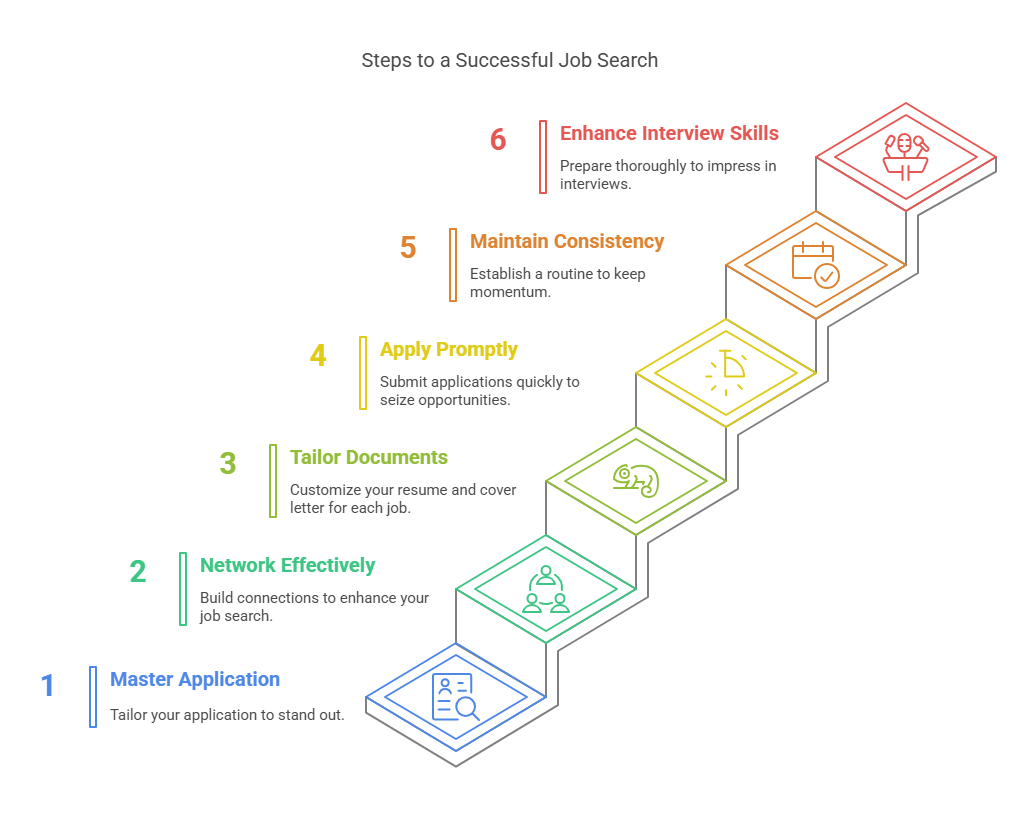
1. Narrow your target to two or three job titles
Vague searches produce vague applications. Before you apply anywhere, write down the two or three titles you qualify for, your must-haves (salary floor, location or remote, schedule) and any companies you want to avoid.
Clear filters make every later step faster, from setting alerts to tailoring your resume. If you are unsure which titles fit, the AI Jobs Personality Test or our free career quiz can suggest directions.
2. Fix your resume once, then tailor the top third
Build one accurate master resume with every role, achievement and number you can stand behind. For each application, adjust the summary, the first bullets of your latest role and the skills section to mirror the posting’s language.
Tailoring pays off. In Huntr’s data, applications sent with a tailored resume led to interviews about twice as often as those sent with a generic one (4.23% vs 2.07%), so run a quick check with a free ATS resume checker before you start.
3. Apply early, and go straight to company career pages
Applications sent in the first days after a posting goes live get read before the pile grows. Set alerts for your titles, check them every morning and visit the career pages of your target employers directly, because many roles appear there first.
This is where software saves the most time. Automated job search watches company career pages and surfaces new matches as they appear, AI automated job application can apply to those matches within your rules, and an AI job tracker logs every submission for you.
4. Search more than one channel
Do not rely on a single job board. Combine one or two large boards, company career pages, Google’s job results and niche boards for your field.
Channel choice matters more than many people expect. In Huntr’s trailing twelve-month data, applications its users found through Google led to interviews 7.12% of the time, versus 2.94% for LinkedIn postings; Huntr notes that Google often routes applicants to the employer’s own application form.
5. Ask for referrals while you apply
Referrals and warm introductions skip the queue. Tell former colleagues, managers, classmates and friends exactly which roles you want, and ask for an introduction rather than a job.
For each target company, find one person you can message: an alum, a former colleague or the likely hiring manager. A short, specific note (“I applied for the data analyst role; could I ask you two questions about the team?”) gets more replies than a general request.
6. Apply to one or two roles per company, not ten
Spreading many applications across one employer looks unfocused and does not raise your odds. In Huntr’s Q1 2026 data, users who applied once at a company interviewed at 6.07% per application, while those who applied eight or more times there interviewed at 1.91%.
Pick the one or two roles that fit best. Our guide to mass applying for jobs the right way explains how to keep volume high without falling into that trap.
7. Track every application and follow up
A tracker turns a pile of applications into a pipeline: company, role, date, contact, status and next step. Follow up politely about five business days after applying if you have a contact, and send a thank-you note within a day of every interview.
A spreadsheet such as our free job application tracker template works fine. If you would rather skip the data entry, let the AI Job Tracker log applications and status changes automatically.
8. Prepare for interviews before you get them
Waiting for an invitation to start preparing costs days. Draft answers to the common questions now (tell me about yourself, why this role, a problem you solved, salary expectations) and rehearse them out loud.
Practice with a friend or an AI interview simulator, so the first real interview is not your first attempt.
9. Consider fast-hire, temporary and contract roles
If income matters more than the perfect title right now, apply to employers that hire quickly: retail, warehouses, delivery, hospitality and staffing agencies. Temporary and contract roles can also turn into permanent offers and keep your resume current.
Our list of jobs that hire immediately covers employers known for same-week decisions.
10. Use free public help
Every state runs American Job Centers with free job search help, workshops and training referrals. The U.S. Department of Labor’s job seekers page lists them alongside job banks and job fairs.
Many colleges also offer career services to alumni, not only to current students. Ask before you pay for coaching.
A week-by-week plan to get hired faster
A plan stops the search from turning into random bursts of applying. Here is a routine you can copy and adjust to your hours.
| When | Focus | What you should have at the end |
|---|---|---|
| Day 1 | Set up | 2-3 target titles, filters, a master resume, a tracker and job alerts |
| Week 1 | Build momentum | 10-15 tailored applications, 5 networking messages, interview answers drafted |
| Weeks 2-4 | Daily routine | A steady flow of tailored applications, follow-ups sent, first interviews booked |
| End of week 4 | Review | Reply rate by job title and channel; changes to targeting or resume |
| Week 5 onward | Adjust and repeat | More of what works, less of what does not |
Your daily routine (60 to 120 minutes)
- 15 minutes: check alerts and company career pages for new postings, and shortlist the best matches.
- 30 to 60 minutes: tailor and submit two to five applications.
- 15 minutes: send one or two networking messages or follow-ups.
- 10 minutes: update your tracker.
- 10 to 20 minutes: rehearse one interview answer out loud.
How many applications you send depends on your situation. Our guide on how many jobs to apply for a day gives targets for full-time searchers, employed searchers and career changers.
Your weekly review
Once a week, open your tracker and answer three questions. Which titles and channels produced replies? Which applications got no response after two weeks, and what will you change this week?
If you have sent 30 or more tailored applications with no interviews, change the targeting or the resume before you add volume. Huntr’s report makes the same point: tighten your targets, tailor every application and treat the first 30 days as the period when momentum builds.
Where to look: job boards, company pages, referrals and AI tools
Each channel has a different speed and level of competition. Most fast searches combine at least three.
| Channel | Speed to apply | Competition | Best for |
|---|---|---|---|
| Large job boards | Fast | High | Breadth and salary research |
| Company career pages | Fast, if you check daily | Lower for fresh postings | Target employers and verified listings |
| Referrals and networking | Slower to set up | Lowest | Getting your application read |
| Staffing agencies and recruiters | Fast for temp and contract roles | Varies | Quick placements and hourly work |
| AI job search and auto-apply tools | Fastest once set up | Depends on fit and tailoring | Steady daily volume without manual forms |
Prices and features of job search tools change often. For a current side-by-side comparison, see our guide to the best AI job application tools.
How AI and automation help you find a job faster
Automation saves the most time on the repetitive parts of a search: finding new openings, filling in the same forms and keeping records. It does not replace your judgment about which roles fit or what to say in an interview.
Used well, it covers four jobs:
- Finding openings early: tools that scan employers’ career pages every day and flag or act on new matches.
- Applying within your rules: tailored applications submitted only to roles that match your titles, locations, salary and exclusions.
- Tracking automatically: every application, date and status logged without data entry.
- Preparing faster: AI drafts of cover letters, screening answers and interview practice that you then edit.
JobsAICopilot is our product. It is an AI job application bot: you upload your resume once and set filters for titles, locations, remote work, salary and excluded companies, and the AI copilot scans 50,000+ company career pages every day, tailors each application and applies for you.
Premium ($14.54 a week) applies to up to 20 jobs a day, and Elite ($17.92 a week) applies to up to 50 a day with an AI-tailored resume for every application. Review Mode lets you approve each application before it is sent, and there is no free trial.
Whatever tool you use, keep three rules. Turn on a review step until you trust the results, apply only to roles you would accept, and keep LinkedIn activity manual, because its User Agreement prohibits “bots or other unauthorized automated methods.” Our guide to auto apply for jobs covers the risks in more detail.
Mistakes that slow a job search down
- Applying to everything. Volume without fit lowers your reply rate and burns your best hours.
- Using one resume for every role. Generic applications rarely survive screening.
- Waiting on one application. Keep applying until you have a signed offer.
- Ignoring your network. Online applications alone are the slowest route for most roles.
- Skipping the tracker. Missed follow-ups and duplicate applications cost interviews.
- Quitting before you have an offer. Searching while employed keeps your income steady and gives you room to negotiate.
- Leaving interview practice for later. The first interview should not be your rehearsal.
How to find a job faster in your situation
If you are employed
Protect your time and your privacy. Aim for one or two strong applications on weekdays, let alerts or automation bring new roles to you, and exclude your current employer in every filter.
If you are unemployed
Treat the search like a part-time job with fixed hours, and add fast-hire or temporary work if your savings are short. Check your state’s unemployment insurance rules early, since claims usually require proof of an active search.
If you are changing careers
Lead with transferable skills and projects, and lean on networking more than volume. The AI Career Change Helper maps your experience to roles in a new field.
If you are a student or recent graduate
Use campus career services, internships and entry-level programs, and apply early in the hiring season. The AI Student Career Helper adds guidance for first jobs.
Put your job search on a faster track
You can run every step in this guide with free tools and a disciplined routine. If you want the searching, applying and tracking handled every day, JobsAICopilot finds matching roles on company career pages, applies within your rules and logs everything, with Review Mode to approve each application.
Start with automated job search and the AI Job Tracker, then compare plans on the pricing page. More guides are in Job Search.
Job Search
Frequently Asked Questions
Still have a question?
Write to contact@jobsaicopilot.com or visit our contact page.
What is the best way to find a job immediately?
Target employers that hire quickly, such as retail, warehouses, hospitality, customer service and staffing agencies, and apply the day a posting appears. Register with one or two temp agencies, tell your network you can start now and keep your phone on: many fast-hire employers schedule interviews within days and some decide on the spot.
Why is it so hard to get a job right now in 2026?
Searches are taking longer. BLS data shows 7.1 million job openings and 5.2 million hires in August 2026, with hires little changed from a year earlier, while Huntr's tracker data put the median time from search start to first offer at 108 days in Q1 2026, up from 83 days a quarter earlier. Targeted, tailored applications and referrals stand out more than volume.
What is the hardest month to find a job?
Late December is usually the slowest stretch, because many decision-makers take holidays and budgets reset in January; mid-summer can also slow down for the same reason. January to March and September to October tend to be busier. Treat these as patterns, not rules: U.S. employers made 5.2 million hires in August 2026 alone, so keep applying year-round.
How to find a job faster online?
Save searches and alerts on two or three job sites, check the career pages of your target employers directly, and search Google for the exact job title plus your city or "remote." Apply within the first few days of a posting, tailor the top third of your resume to each role, and use a tracker so follow-ups happen on time.
How to get a job fast with no experience?
Aim at entry-level and high-turnover roles that train on the job, such as retail, food service, warehouse, call center and seasonal work. Lead your resume with transferable skills, volunteering, school projects and reliability, apply in person where you can, and ask friends and family for referrals. Temporary and staffing-agency roles are often the quickest route to a first reference.


