
Mass Applying for Jobs: Does It Work and How to Do It Right
Does mass applying for jobs work? How many applications to send, how to keep each one tailored, and how to automate it without getting flagged.

Mass applying for jobs works when the volume stays targeted: sending many applications to roles you genuinely fit, each with a tailored resume, raises your odds of landing interviews. Blasting one generic resume at hundreds of postings mostly lowers your reply rate and can get your accounts flagged. In Huntr’s Q1 2026 data, people who sent 11 to 20 applications interviewed at 9.25% per application, against 2.58% for those who sent 100 or more.
This guide covers what works, how many applications to send and how to automate safely, whether you apply by hand or with an AI job application bot.
Key takeaways
- Mass applying works as targeted volume: many applications to roles you fit, each one tailored.
- Interview rates per application fall as volume rises, and tailored resumes were interviewed about twice as often as generic ones in 2026 tracker data.
- Apply to no more than two or three roles per company; eight or more applications at one employer cut the interview rate to 1.91%.
- Automate the repetitive steps, but keep filters tight, a review step on and LinkedIn activity manual.

What mass applying means (and what it is not)
Mass applying means submitting a high number of job applications in a short time, usually with templates, quick-apply buttons or automation. The label covers very different approaches, and the difference decides whether it works.
| Approach | Volume | Tailoring | Typical outcome |
|---|---|---|---|
| Spray and pray | 50-100+ a day | None; one resume for everything | Low reply rate, duplicate and off-target applications |
| Targeted volume | 10-50 a day | Resume tailored to each role or role type | More interviews per hour spent |
| Selective applying | 1-5 a day | Fully customized, plus networking | Highest rate per application, slowest pipeline |
Most people get the best results from targeted volume, plus a few fully customized applications for their top-choice employers. Automated job search finds matching openings on company career pages, and AI automated job application tailors and submits them within your filters, which is what makes targeted volume practical.
Who mass applying suits, and who it does not
Targeted volume fits people whose skills match many similar postings: customer service, sales, administration, operations, software and other roles that many employers hire for at once. It also helps when you need income soon and can start quickly.
It suits you less if you are changing careers, aiming at senior or specialist roles, or targeting a short list of employers. In those cases, a few researched applications plus referrals and direct messages to hiring managers usually beat a long list.
Does mass applying work? What the 2026 data shows
Huntr’s Q1 2026 Job Search Trends Report analyzed about 140,000 applications that 25,635 job seekers logged in its tracker between January and March 2026. Three findings matter for anyone applying at volume.
| Finding | Interview rate per application |
|---|---|
| Sent 11-20 applications in the quarter | 9.25% |
| Sent 21-50 applications | 6.96% |
| Sent 51-100 applications | 4.65% |
| Sent 100+ applications | 2.58% |
| Tailored resume (all applications logged) | 4.23% |
| Untailored, base resume | 2.07% |
The data has limits. Heavy appliers may be in tougher fields, and tracker numbers depend on users updating them, so these are correlations rather than proof.
Still, every cut of the data points the same way: volume without tailoring and focus loses efficiency fast. The goal is more interviews per application, so the volume you send actually converts.
Volume does have a place. Among Huntr users who landed an offer after logging at least 11 applications, about 35% needed more than 50 applications, so a long list of well-matched applications is normal.
Applying to several jobs at the same company
Many people apply to every opening at a company they like. The same report suggests this backfires.
| Applications at one company | Interview rate per application |
|---|---|
| 1 | 6.07% |
| 2-3 | 4.64% |
| 4-7 | 3.34% |
| 8 or more | 1.91% |
Recruiters can usually see every application you send to their company in the applicant tracking system, and very different roles from one person look unfocused. Pick the one to three roles that fit best, space them out and make sure each application explains why that specific role.
How to mass apply for jobs the right way
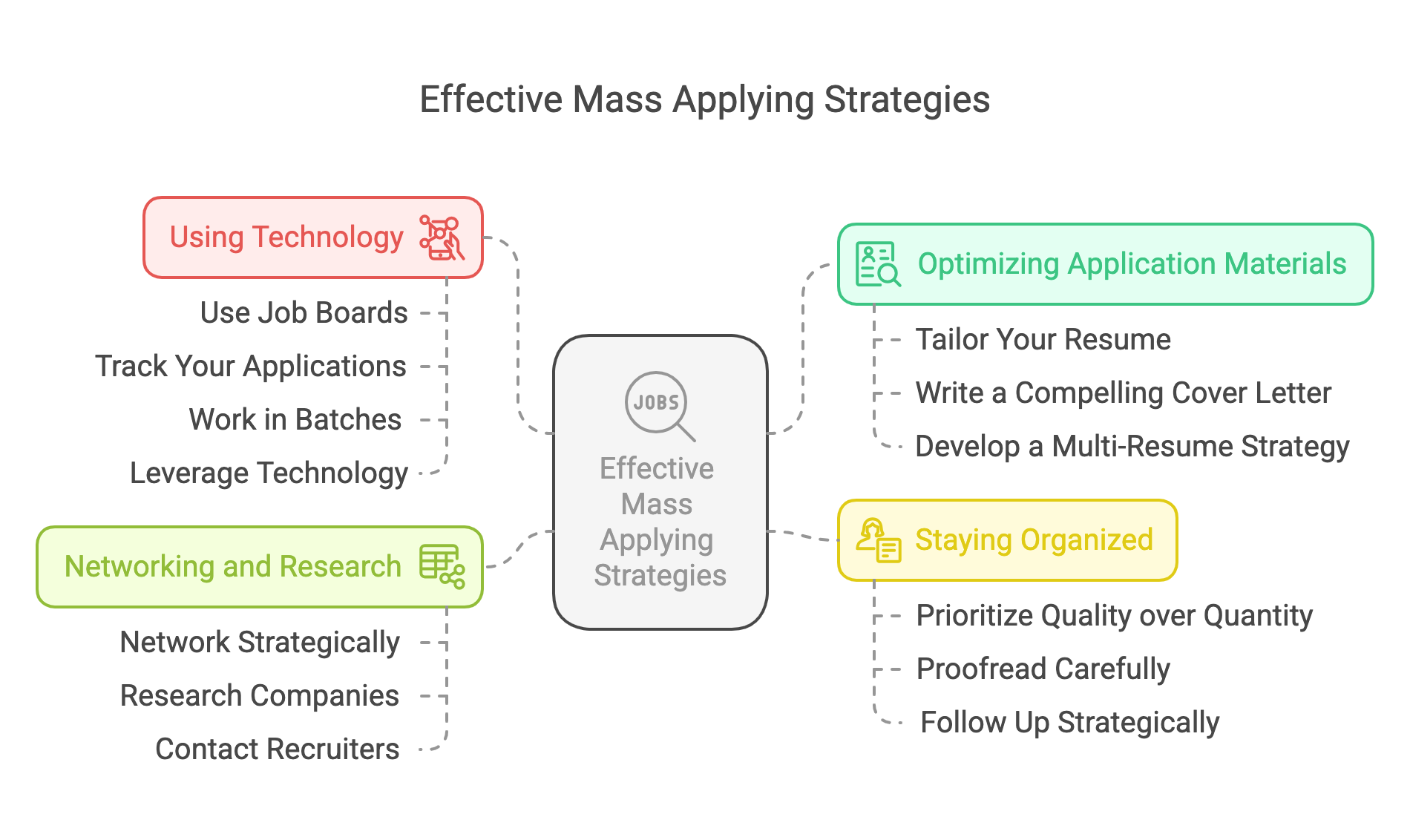
1. Define your targets and filters
Choose two or three job titles, the locations or remote options you accept, your salary floor and the companies to exclude. Tight filters are what separate targeted volume from spray and pray.
2. Build a master resume and a few versions
Keep one complete, accurate master resume, then create two or three versions for your main role types. Each version should lead with the skills and results that role type cares about most.
3. Tailor every application
For each posting, align the summary, the first bullets of your latest role and the skills section with the job description, using only true facts. Apply where you meet most of the core requirements, not every line.
4. Work in batches
Instead of finishing each application from start to finish, batch the steps: shortlist roles, tailor resumes, then submit. Batching cuts context switching and keeps quality consistent across a long list.
5. Apply early and on company career pages
New postings get read before the pile grows. Company career pages also give you the employer’s own application form and help you avoid reposted or fake listings.
6. Track and follow up
Log every application with the date, role, contact and status. Follow up on the ones that matter most, and start preparing as soon as interviews come in.
7. Review your numbers weekly
Check replies by job title and source each week. If 30 or more tailored applications bring no interviews, fix your targeting or resume before adding volume; our guide on how many jobs to apply for a day gives daily targets by situation.
What to template and what to personalize
Templates are what make volume possible, but only some parts of an application should be reused. Use this split to save time without sending generic applications.
| Reuse freely | Personalize every time |
|---|---|
| Contact details, work history, education | Company name and job title (check twice) |
| A library of answers to common screening questions | The opening line of the cover letter: why this role |
| Two or three resume versions by role type | The summary and top bullets, matched to the posting |
| A cover letter structure with fixed middle paragraphs | One sentence on something specific to the employer |
| Follow-up email templates | The name of the hiring manager or team |
A good rule: if a sentence would fit an application to any employer, it can be templated. If it names the employer or the role, write it fresh, or let an AI draft it and check it yourself.
How to automate mass applying without getting flagged
Automation is how most people reach real volume, but it comes with rules. Follow these to protect your accounts and your reputation.
- Respect platform terms. LinkedIn’s User Agreement prohibits using “bots or other unauthorized automated methods” on its services, so keep LinkedIn activity manual.
- Prefer official company career pages. Applying through the employer’s own site avoids job-board limits and most fake listings.
- Set a sensible daily cap. A steady daily number of relevant applications is safer and more effective than hundreds in one burst.
- Keep a review step. Approve applications before they go out until you trust the tailoring and the screening answers.
- Answer screening questions truthfully. Work authorization, experience and salary answers must be accurate; automation should never guess.
- Avoid duplicates. Exclude companies you already applied to and limit the number of roles per employer.
For a deeper look at tools and risks, read our guides to auto apply for jobs, the best AI job application tools and how to use AI to apply for jobs.
How JobsAICopilot handles volume
JobsAICopilot is our product. It scans 50,000+ company career pages every day for roles that match your filters, tailors each application and applies for you, only to verified listings on official company career pages.
Premium applies to up to 20 jobs a day ($14.54 a week, one copilot), and Elite applies to up to 50 a day ($17.92 a week, three copilots) with an AI-tailored resume for every application. Review Mode lets you approve every application before it is sent, and there is no free trial.
Ways to apply at volume, compared
There are four common ways to send many applications. They differ in who does the work and how much control you keep.
| Method | Who submits | Speed | Tailoring | Your control |
|---|---|---|---|---|
| Quick-apply buttons on job boards | You | Fast for supported postings | Usually none | Full, one by one |
| Autofill browser extensions | You, after the form is filled | Medium | Depends on the tool | Full, you click submit |
| AI job application bots | The tool, within your filters | Fastest once set up | Often per application | Filters, daily limits and review steps |
| Done-for-you application services | People working for you | Varies | Varies | Limited; you rely on the service |
Our comparison of job application services, AI vs human covers the done-for-you option, including the questions to ask before you pay.
Signs your mass applying is not working
Watch for these signals in your tracker. Each one means it is time to tighten targeting rather than add volume.
- Rejections within hours. Automated knockouts often mean you miss a hard requirement or a screening answer.
- Replies only for roles you do not want. Your filters or resume title point employers in the wrong direction.
- No replies after 30 or more applications. The resume, the titles you target or the channel needs work.
- Recruiters mention your other applications. You are applying to too many roles at the same company.
- Errors in submitted applications. Wrong company names or mismatched answers mean the pace is too high for your review process.
Pros and cons of mass applying
| Pros | Cons |
|---|---|
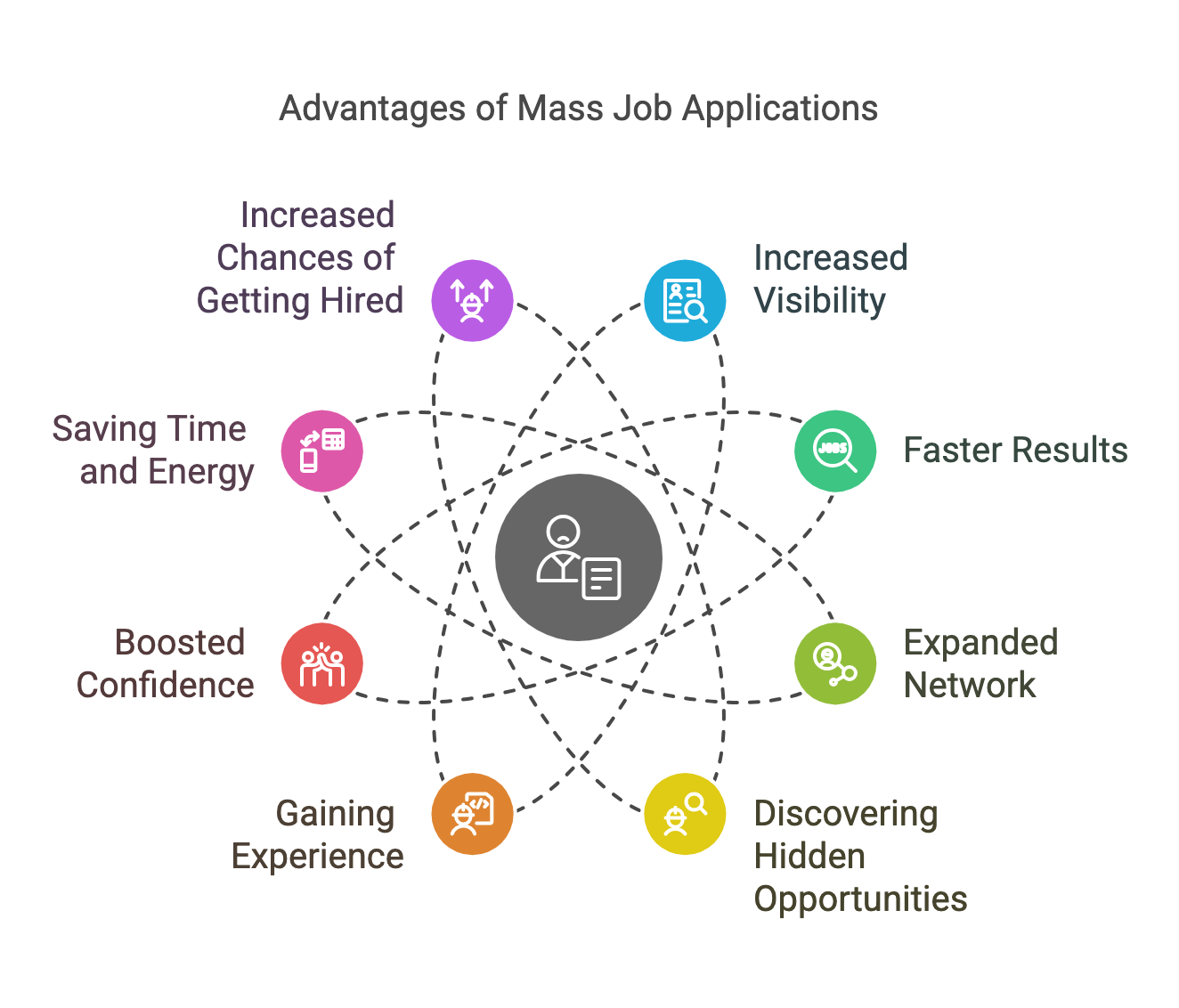
| More chances to reach the right employer | Lower interview rate per application when tailoring slips |
| A faster pipeline and more interview practice | Risk of duplicate or off-target applications |
| Several offers can strengthen your negotiating position | Harder to prepare for many interviews at once |
| Less time per application when automated | Account limits on platforms that ban bots |
| Momentum instead of waiting on a single job | Burnout if you apply by hand at high volume |
Mass applying myths
Myth: it is a pure numbers game. Numbers matter, but conversion matters more; in the data above, one tailored application was worth about two generic ones.
Myth: recruiters cannot tell. Applicant tracking systems record every application you send to a company, and identical generic letters stand out.
Myth: mass applying is always impersonal. Targeted volume with tailored resumes, plus a few personal notes to hiring managers, keeps it personal where it counts.
Myth: more automation means less control. Filters, daily limits and approval steps let you decide exactly what is sent.
Apply at volume, with quality intact
If you want targeted volume without spending your evenings on forms, set your filters in JobsAICopilot, approve the first applications in Review Mode and let the copilot handle the daily applying.
See how AI automated job application works, then choose weekly, monthly or quarterly billing on the pricing page. More guides are in Applying for Jobs.
Applying for Jobs
Frequently Asked Questions
Still have a question?
Write to contact@jobsaicopilot.com or visit our contact page.
Is it possible to mass apply for jobs?
Yes. You can apply to many jobs quickly with quick-apply buttons on job boards, autofill browser extensions that fill in forms for you, or AI job application bots that find matching roles and submit applications automatically. The method matters less than the targeting: applications to roles you fit, sent with a tailored resume, are the ones that lead to interviews.
Should I mass apply to jobs?
Apply at volume only to roles you genuinely fit and would accept. In fields with many similar openings, such as customer service, sales or software, targeted volume can shorten your search. If you are changing careers or aiming at senior roles, fewer researched applications plus networking usually work better than mass applying.
Can you apply to multiple jobs at once?
Yes, and you should: waiting on one application at a time slows your search. Keep several applications in progress across different employers, tailor each one, and track them so you can follow up and prepare for every interview. At a single company, limit yourself to two or three closely related roles so your interest stays clear.
Can AI mass apply to jobs for you?
Yes. AI job application bots read your resume and filters, find matching openings and submit applications for you, often with a tailored resume or cover letter. Quality varies between tools, so choose one with daily limits, clear filters and a way to review applications before they are sent, and check the first results yourself.
Can you mass apply to jobs for free?
Partly. Job boards offer free quick-apply buttons, many autofill extensions have free tiers, and a spreadsheet tracker costs nothing. Fully automated daily applying usually requires a paid plan, and JobsAICopilot has no free trial. Free methods still need your time for searching and tailoring, so they suit smaller, highly targeted batches.


