
What are Application Based Questions?
Application-based questions explained: what they test, how they differ from behavioral questions, plus the STAR method and sample answers by role.

Application-based questions ask you to apply what you know to a real situation instead of reciting a definition: “Tell me about a time you…” or “What would you do if…”. In a job interview they test how you actually work, and the most reliable way to answer them is a short, specific story told with the STAR method (situation, task, action, result).
They matter more than ever because getting an interview has become easier than getting the offer. Whether you apply to roles one by one or let an AI job application bot send applications for you, these questions are where you prove the experience on your resume. This guide covers what they are, why employers use them, five worked answers by role and a template you can copy.
Key takeaways
- Application-based questions ask you to use real experience (“Tell me about a time…”) or judgment (“What would you do if…”), not to define a concept.
- Behavioral questions look at what you did in the past; situational questions are hypothetical. Both are application-based, and both are standard in structured interviews.
- Answer with STAR in one to two minutes and spend most of that time on the actions you personally took.
- Prepare five to seven true stories in advance; one good story can answer several different questions.
- Practise out loud with questions for your target role before the real interview.

What are application-based questions?
An application-based question asks you to show how you handled a situation in the past, or how you would handle a realistic one, so the interviewer can see how you think and act rather than what you can recite. They test judgment and proven behavior, not memory.
The easiest way to spot one is to compare it with a knowledge question on the same topic:
| Knowledge question | Application-based version |
|---|---|
| What is good customer service? | Tell me about a time you turned an unhappy customer around. |
| What is a KPI? | Sign-ups fell 20% last month. Which numbers would you check first, and why? |
| Do you know Excel? | Walk me through a spreadsheet you built that saved your team time. |
| Are you organized? | How did you handle the week you had three deadlines at once? |
They usually start with phrases like:
- “Tell me about a time when…”
- “How would you handle…”
- “What would you do if…”
- “Can you walk me through a situation where…”
Not “What are your strengths?” Not “Where do you see yourself in five years?” These questions are designed to show how your skills, experience and personality hold up under pressure.
Application questions in school and on tests
Outside hiring, “application question” is a teaching term. In Bloom’s taxonomy, the classification of learning objectives proposed in 1956 by University of Chicago educational psychologist Benjamin Bloom, “apply” is the level where students use a concept in a new situation, such as solving a word problem instead of recalling a formula. The University of Arkansas teaching guide on using Bloom’s taxonomy points out that an application-level objective can’t be proven with a multiple-choice quiz alone. The interview version follows the same logic: the question checks whether you can use what you know.
Why employers ask application-based questions
Nobody is persuaded that you are “a great problem-solver” because you say so. Interviewers want evidence, and application-based questions help them:
- Predict how you will behave on the job
- See whether you have handled similar problems before
- Check your decision-making, communication and leadership
- Separate candidates who use buzzwords from candidates who have done the work
There is research behind this. The U.S. Office of Personnel Management’s guidance on structured interviews explains that interviews asking every candidate the same job-related questions, scored against set benchmarks, show higher validity and rater reliability than unstructured chats. It describes the two main formats, situational and behavioral, and notes that behavioral questions rest on the principle that past behavior is the best predictor of future behavior.
Your resume gets you into the room, whether you wrote it by hand or with an AI resume creator. If you use AI automated job application to apply at volume, you may also face more interviews in a shorter time, so a prepared set of stories pays off quickly. You can rehearse them with an AI interview simulator that asks role-specific follow-up questions.
What skills do these questions test?
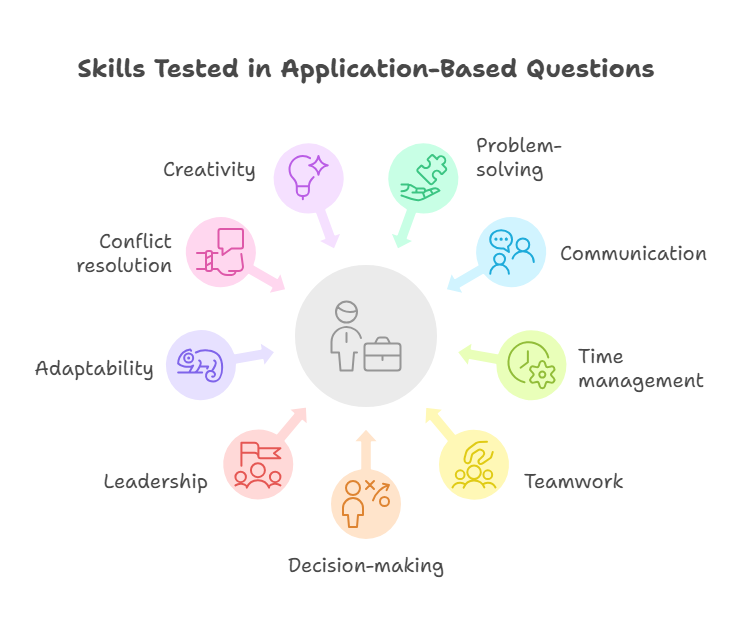
Different jobs stress different skills, but most application-based questions target one of these:
| Skill | Typical question | What the interviewer listens for |
|---|---|---|
| Problem-solving | ”Describe a problem you solved without guidance.” | How you diagnosed the cause, not just the fix |
| Communication | ”Tell me about a time you explained something complex.” | Whether you adapt to the audience |
| Time management | ”How do you prioritize when everything feels urgent?” | A clear method, not “I work harder” |
| Teamwork | ”Tell me about a disagreement with a colleague.” | Respect, listening and a shared outcome |
| Decision-making | ”Describe a tough call you made with incomplete information.” | Your reasoning and how you managed risk |
| Leadership | ”Give an example of motivating someone.” | Influence without relying on a title |
| Adaptability | ”Tell me about a major change at work.” | Speed of learning and attitude |
| Conflict resolution | ”How did you handle an unhappy client?” | Calm, ownership and follow-up |
| Creativity | ”Tell me about an idea you introduced.” | Originality that produced a result |
In short, they test whether you are good on the job, not just on paper.
Behavioral vs situational questions
You will hear both terms. They are closely related, and both are application-based:
| Behavioral question | Situational question | |
|---|---|---|
| Time frame | The past: something you did | The future: a hypothetical scenario |
| Typical opener | ”Tell me about a time…" | "What would you do if…” |
| What it tests | Proven behavior | Judgment and approach |
| Example | ”Tell me about a time you missed a deadline. What happened?" | "What would you do if you were assigned a task outside your skill set?” |
| How to answer | A STAR story | Your steps and reasoning, ideally backed by a similar real example |
Behavioral questions assume that how you acted before says a lot about how you will act again. Situational questions don’t require you to have lived the scenario, but you still need to explain a sensible approach. Neither can be answered with “I’m hardworking and punctual.”
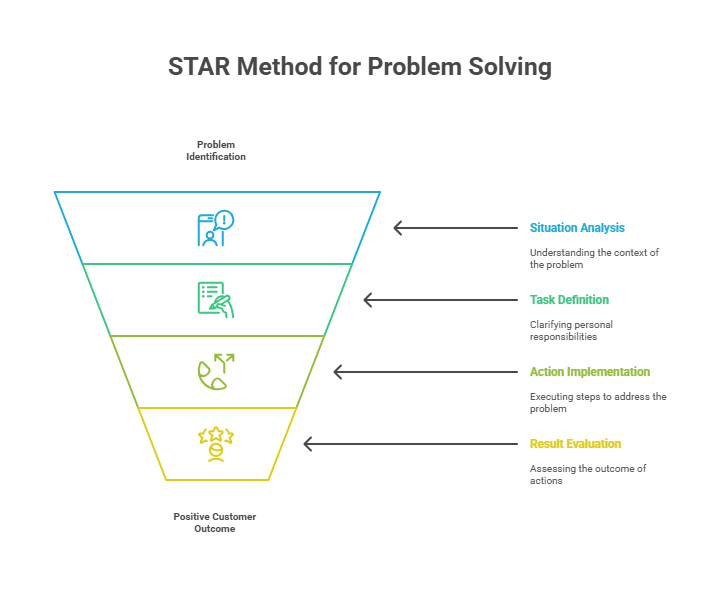
How to answer with the STAR method
STAR keeps you from rambling or freezing. Here is each step with a running example.
S: Situation
Give just enough context.
“At my last job, a customer placed a large order that was delayed by a supplier issue.”
T: Task
State what you were responsible for.
“I had to tell the customer, manage their expectations and find a solution.”
A: Action
Explain what you did. Not your team. You.
“I called the customer personally, explained the delay, offered a partial shipment and followed up every day.”
R: Result
Say how it ended, with a number if you have one.
“The customer appreciated the transparency and became a repeat buyer.”
A STAR template you can copy
Situation: At [company or role], [one sentence of context]. Task: I was responsible for [goal or problem], with [constraint: time, budget, people]. Action: I [step one], [step two] and [step three], because [your reasoning]. Result: [Measurable outcome], and [what you learned or what changed afterwards].
A useful rule of thumb: spend about a fifth of the answer on the situation and task, most of it on your actions, and finish with the result.
Application-based question examples by role
Five worked answers to adapt with your own details. Never invent a story.
Customer service representative
Question: “Tell me about a time you dealt with an angry customer.”
Answer: “A customer called about a double charge and threatened to cancel (S). I owned the call because I was on the billing queue (T). I apologized once, confirmed the duplicate in our system, issued the refund while he was on the line and emailed the confirmation number (A). He stayed, and our team later added a duplicate-charge alert that cut those calls (R).”
Software engineer
Question: “Describe a time you fixed a production issue under pressure.”
Answer: “Checkout errors spiked after a Friday release (S). I was on call, so restoring service was my job (T). I rolled back the release first, then reproduced the bug locally, found a missing null check and shipped a tested fix with a regression test (A). Checkout recovered within the hour, and we added a canary step to deployments (R).”
Registered nurse
Question: “Tell me about a time you had to prioritize several patients at once.”
Answer: “On a night shift I had a new admission while two post-op patients needed pain reassessments (S). I had to keep everyone safe without delaying care (T). I assessed the admission’s vital signs first, asked a colleague to cover one reassessment and escalated an abnormal reading to the charge nurse (A). All three were seen within protocol times (R).”
Retail sales associate
Question: “What would you do if a customer wanted to return an item without a receipt?”
Answer: “I would stay friendly, check our policy and look the purchase up by card or loyalty number. If store policy allowed only store credit, I would explain that clearly and offer it. At my last store this happened weekly, and checking the loyalty lookup first solved most cases without a manager.”
Project manager
Question: “Tell me about a project that fell behind schedule.”
Answer: “A website migration slipped two weeks when a vendor missed a delivery (S). I owned the launch date (T). I re-planned the critical path, moved content work earlier and agreed a reduced first release with stakeholders (A). We launched one week late instead of three, and I added vendor checkpoints to our project template (R).“
20 common application-based interview questions
Let’s make this practical. Here are questions you are likely to hear, grouped by skill.
Problem-solving
- “Tell me about a time you faced a major obstacle at work. What did you do?”
- “How do you prioritize when everything feels urgent?”
- “Describe a time you had to solve a problem without guidance.”
Teamwork and communication
- “Have you ever had a conflict with a coworker? How did you handle it?”
- “Tell me about a time you had to work with someone difficult.”
- “How do you handle feedback you don’t agree with?”
Time and project management
- “Describe a time you missed a deadline. What went wrong?”
- “How do you manage multiple tasks with tight deadlines?”
- “Have you ever had to lead a project under pressure?”
Leadership and initiative
- “Give an example of a time you took initiative at work.”
- “How have you motivated a team or colleague?”
- “Have you ever had to make a tough decision without support?”
Customer-facing scenarios
- “Tell me about a time a client was unhappy. How did you solve it?”
- “What do you do when a customer is completely wrong?”
- “How do you handle high-pressure situations with customers?”
Adaptability and learning
- “Have you ever had to learn something quickly for a job?”
- “Tell me about a time you had to adapt to major changes at work.”
- “How do you handle being given a task outside your comfort zone?”
Ethics and judgment
- “What would you do if you saw a coworker doing something unethical?”
- “Have you ever made a mistake at work? How did you handle it?”
These are standard across industries. Large employers use the same pattern; see the questions candidates report in our guide to Walmart interview questions.
Application questions on job application forms
Many online application forms include short written questions such as “Describe a time you went above and beyond” or “Why do you want to work here?” Treat them as written STAR answers: 100 to 150 words, one specific example and, where possible, one number. If you apply with an automated tool, use a review step for applications with open-ended questions so you can check every answer before it is sent.
Pro tips to nail these questions
1. Write down five to seven real stories
Think challenges, wins, failures, team projects, difficult clients and new tasks. You will reuse each story across several questions.
2. Practise out loud
You will hear straight away whether an answer sounds natural or rehearsed. Use a friend, a mirror or a mock-interview tool.
3. Don’t try to be perfect
Mistakes are fine if you learned something. A recovery story is often more convincing than one where everything went smoothly.
4. Be specific
Avoid vague lines like “We worked hard and fixed it.” Say what you did, why it worked and what changed.
5. Keep it short
Aim for one to two minutes, then stop talking.
What not to do
- Don’t invent stories. Follow-up questions expose made-up details quickly.
- Don’t blame others. Even if the story involves a bad manager, keep it professional.
- Don’t memorize scripts word for word. You will sound robotic; memorize the beats, not the sentences.
- Don’t ramble. If the interviewer starts checking the time, you have lost them.
Sample answer, broken down
Question: “Tell me about a time you had to learn something quickly.”
S: “At my last job, our designer left right before a product launch.” T: “As the content manager, I had to step in and create the social media visuals.” A: “I spent a weekend learning Canva, followed our brand guide, made all the promo content for launch week and asked a designer friend to review it.” R: “The launch went well and engagement was high. My manager appreciated it, and I took on light design work regularly after that.”
Why it works: one-sentence context, concrete actions and a result that shows lasting trust.
Final thought: these questions are your best chance to stand out
Application-based questions are the part of the interview you can prepare for most, and your chance to show who you are beyond your resume. If you are still earlier in the process, read our guide on how to find a job faster; once an offer arrives, see whether you can lose a job offer by negotiating salary. For more guides like this one, browse Applying for Jobs.
Ready to practise? Rehearse these questions with the AI Interview Simulator, included in every JobsAICopilot plan along with automated job applications, and compare Premium and Elite on the pricing page.
Applying for Jobs
Frequently Asked Questions
Still have a question?
Write to contact@jobsaicopilot.com or visit our contact page.
What is an application-based question?
An application-based question asks you to use your knowledge or experience in a realistic situation instead of defining a term. In job interviews it usually starts with "Tell me about a time…" or "What would you do if…". On school tests it asks you to use a concept in a new problem, the "apply" level of Bloom's taxonomy.
What is an example of an application question?
A classic interview example is: "Tell me about a time you had to deal with a difficult customer. What did you do?" It asks for a real situation, the steps you took and the result. A test version works the same way: instead of "What is a percentage?" you get a word problem where you must work out a discount.
What are some examples of application-based questions?
Common examples are "Describe a time you missed a deadline," "How do you prioritize when everything feels urgent?", "Tell me about a conflict with a coworker," "Give an example of a time you took initiative," and "What would you do if you saw a coworker doing something unethical?" Each one asks you to prove a skill through a real or realistic situation.
How to answer application-based questions?
Use the STAR method. Describe the Situation briefly, state your Task, spend most of the answer on the Actions you personally took, and finish with a measurable Result or a lesson learned. Keep it to one or two minutes, use a true story, and prepare five to seven stories in advance so you can adapt them to different questions.


