AI Interview Assistant: An Honest 2026 Guide to Real-Time Copilots
AI interview assistant guide: how real-time copilots and practice tools differ, 8 tools with prices checked October 2026, employer rules and legal risks.
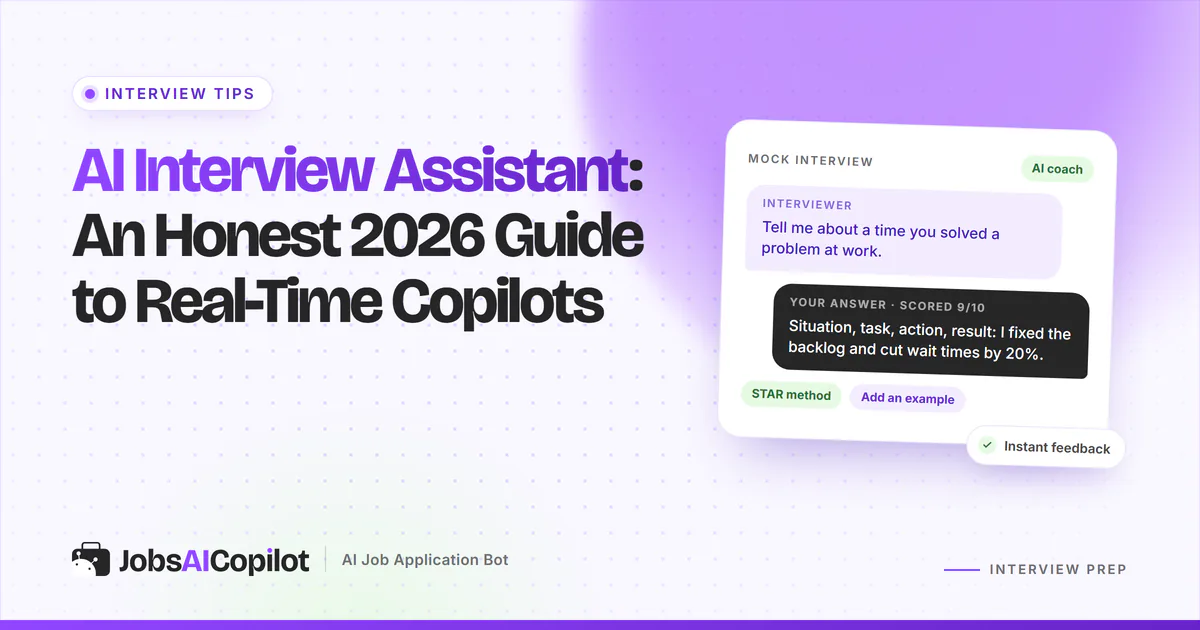
An AI interview assistant is software that uses AI to help you with an interview in one of two ways: real-time copilots listen to a live call and suggest answers on screen, while practice assistants run mock interviews beforehand and score your answers. Practice tools are safe to use anywhere. Live copilots are banned by many employers and can cost you the job.
Key takeaways
- Two different products share the name: real-time copilots (during the interview) and practice assistants (before and after it).
- Amazon told recruiters in early 2025 that candidates may be disqualified for using AI tools in an interview unless explicitly permitted (Business Insider, February 27, 2025).
- Listed prices run from a $0 tier to EUR 129.90 a month (ParakeetAI); live use almost always needs a paid plan.
- No “undetectable” claim has been independently verified, and recording rules differ by state.
- The safest edge is preparation: role-specific mock interviews, STAR stories and feedback loops.
What is a real-time AI interview assistant?
A real-time AI interview assistant, often called an interview copilot, is an app that listens to your video or phone interview, transcribes the interviewer’s questions and displays suggested answers on your screen within seconds. Most use your resume and the job description as context so the suggestions sound relevant.
In practice, a copilot is a desktop app or browser extension that captures audio from Zoom, Google Meet or Microsoft Teams, sends it to a speech-to-text and language model, and shows the result in an overlay. Many add coding help for technical rounds and a post-interview summary. The vendor pages checked for this guide describe exactly this loop, and some sell it as “stealth”, a claim covered in the risks section below.
The weakness is built in. You read while someone is speaking to you, which slows replies and flattens your delivery, and the answer is generic unless you gave the tool real detail about your experience.
AI is also changing the step before the interview: an AI job application bot can find roles and send applications, which makes the interview the part you still have to earn yourself.
How is a live copilot different from an AI interview practice tool?
A live copilot works during the real interview and gives you answers; a practice tool works before it, asks you questions and gives feedback on what you said. The first replaces your thinking in the moment, the second builds it.
| Real-time copilot | Practice assistant (mock interviews) | |
|---|---|---|
| When you use it | During the actual interview | Before and after it |
| What it does | Transcribes questions, suggests answers | Asks questions, scores your answers |
| Who writes the answer | The AI, then you read it | You, then the AI critiques it |
| Employer policy | Banned or restricted by many | Not restricted |
| Risk to your candidacy | High | None |
| Skill left afterward | Little | A rehearsed, repeatable answer |
JobsAICopilot’s AI interview simulator belongs in the second column. It is a practice tool: it builds a mock interview from the job you are targeting, and it is not designed to be used during a real interview. For a wider look at the practice category, see our best AI interview practice tools comparison.
Which AI interview assistants exist, and what do they cost?
Eight tools are compared below, including our own practice tool. Prices were read from each vendor’s own pricing page (checked October 2026, on the 18th); where a page did not show a price in a form we could read, the table says “not published”. Vendors change prices often, so confirm before you pay.
| Tool | Type | Platforms listed | Price on its own pricing page (checked Oct 18, 2026) | Free tier |
|---|---|---|---|---|
| Final Round AI | Both: live copilot plus practice interviews | Zoom, Meet, Teams, Webex, HackerRank, CoderPad; macOS and Windows | Pro shown as $25+ a month (“save up to 40%“) | Yes, $0 plan, but no live use; no free trial |
| Sensei AI | Real-time copilot, resume builder | Zoom, Teams, Google Meet | Pro $89 a month, or $24 a month billed annually | Yes, free plan with 15-minute copilot sessions |
| Interview Sidekick | Both: real-time help and mock interviews | Zoom, Teams, Meet (shown on its site) | Not published (page loaded no price) | Yes, limited free tier |
| LockedIn AI | Real-time copilot | Not stated | Not published (homepage names premium plans only) | “Free to start”, amount of free credit not stated |
| ParakeetAI | Both: live assistant plus mock interviews | Windows, macOS, Chrome | EUR 129.90 a month, EUR 519.90 a year, or EUR 67 a week; credit packs from EUR 51 | Yes, one 10-minute free session |
| Interview Copilot AI | Real-time copilot | Zoom, Meet, Teams; Mac and Windows | $49 a month, or $149 billed yearly | None listed |
| InterviewFox | Real-time copilot | Not stated | Credit packs, one-time: $58, $89, $129 | None listed |
| JobsAICopilot AI Interview Simulator (our product) | Practice only, not real-time | Web app | Included in Premium ($14.54 a week) and Elite ($17.92 a week) | No free trial |
Two things stand out. First, live copilots are priced like a subscription you use for a few weeks, because most people need one only while interviewing. Second, the free tiers of live tools are mostly short sessions or setup modes: Final Round AI states that live sessions need an active Pro subscription.
If you want deeper detail on two of them, we have reviews of Final Round AI and Sensei AI.
How our simulator works: it uses the job title and description you give it as the target role, asks behavioral, situational, technical and general questions, lets you answer by typing or by recording your voice, and gives instant feedback on content, relevance and delivery after every answer. You can practice as often as you need.
What are the risks of using an AI interview assistant live?
The main risks are breaking an employer’s rules, losing the offer, creating a recording-consent problem and handing your data to a third party. Each is documented below with a source and date.
Employers ban it, and some are changing how they interview
Amazon told its internal recruiters that applicants can be disqualified if found to have used an AI tool during an interview, calling it an “unfair advantage”, according to guidelines obtained by Business Insider (February 27, 2025). The guidelines say candidates should not use generative AI tools “unless explicitly permitted”.
Google’s CEO Sundar Pichai said on the Lex Fridman podcast in June 2025 that Google had reintroduced at least one round of in-person interviews, and the Wall Street Journal reported that McKinsey asks hiring managers to schedule at least one in-person meeting before an offer (both as summarized by Entrepreneur, August 18, 2025). The direction is clear: companies that worry about live AI help are adding a round where it cannot be used.
Disqualification and rescinded offers
A candidacy can end the moment an interviewer suspects outside help, and an offer can be withdrawn if misrepresentation surfaces later. Amazon’s guidance cited above names disqualification as the consequence, and employment paperwork commonly asks you to confirm that your application is honest. Ask yourself whether you could do the work if the tool disappeared on day one, because that is what the employer is trying to find out.
Recording and consent laws
Tools that capture a call may record or transcribe other people. Under federal law, intercepting a communication is not unlawful when you are a party to it or one party has consented, as 18 U.S.C. 2511(2)(d) provides. States can be stricter: Justia’s 50-state survey (last reviewed September 2024) lists California, Florida, Maryland, Massachusetts and Pennsylvania as all-party consent states and Illinois and Washington as generally all-party. If the interviewer is in such a state, recording them without consent could be a legal problem on top of a hiring problem. This is general information, not legal advice.
Privacy of your resume and audio
A copilot needs your resume, the job description and the live audio. That personal data sits on a vendor’s servers under its retention rules. Read the privacy policy before uploading, trim anything you do not need to share, and look for a clear way to delete your data.
”Undetectable” is a marketing claim
Several vendors advertise stealth features. No independent test supporting those claims is public, a tool that works today can be broken by the next video-call update, and detection is not only technical: interviewers notice delayed answers and answers that fall apart under follow-up questions. This guide does not cover how to hide software, because the better question is whether you should use it at all. The same question comes up for written applications; see our guide on whether employers can tell you used AI on a resume or cover letter.
When is using AI for interviews completely fine?
Using AI is fine when it is part of your preparation or review, and when an employer explicitly allows it in the interview. Preparation, practice and after-the-fact analysis are not restricted by anyone.
Some employers are changing their stance. Meta confirmed to Business Insider (July 29, 2025) that it would let some candidates use an AI assistant in a new type of coding interview, and the same report noted that Anthropic had first told applicants not to use AI assistants during the application process before reversing course. Google followed: according to an internal document reported by Business Insider (May 7, 2026), from the second half of 2026 Google lets candidates for junior to mid-level software engineering roles on select US teams use an “approved” AI assistant in its “code comprehension” round, where interviewers evaluate AI fluency. The lesson: the rule belongs to the employer and can differ even between interviews at one company. Read the invitation, and if it is silent, ask the recruiter in writing.
Safe uses include:
- generating likely questions from a job description and answering them aloud;
- getting feedback on structure, length and filler words in a recorded practice answer;
- turning your experience into STAR outlines;
- reviewing your answers after a real interview to see what to improve.
Which option should you choose? A decision guide
Choose a practice assistant unless the employer has explicitly allowed live AI help. If it has, a copilot is a reasonable tool, and you should pick one by price and platform support.
| Your situation | Best fit |
|---|---|
| Interview is more than 2 days away | Practice assistant, then a human mock |
| Employer says AI is not allowed, or says nothing | Practice assistant only |
| Employer explicitly allows AI during the interview | A copilot is acceptable; test it in a mock call first |
| Coding round where AI is permitted | Check the stated rules; practice with the same tools you will be allowed to use |
| Nervous speaker, answers ramble | Recorded practice with delivery feedback |
| Switching careers | Practice assistant plus a prepared “why the switch” story |
How to prepare without a live crutch: an AI interview assistant for before and after the interview
You can use AI around the interview instead of during it: before to rehearse, after to follow up and negotiate. Each step below maps to a tool that is built for it.
| Stage | What to do | Tool |
|---|---|---|
| Before | Run a role-specific mock interview built from the real job description | AI Interview Simulator |
| Before | Make your resume consistent with the stories you will tell, because interviewers question you on it | AI Resume Creator |
| Before | Prepare “why the switch?” and transferable-skills answers | AI Career Change Helper |
| Before | Prepare for a first interview | AI Student Career Helper |
| Tracking | Move each role through saved, applied, interviewing and offer | AI Job Tracker |
| After | Send a thank-you note within a day | Interview thank-you email generator (free) |
| Offer | Compare the offer with salary benchmarks and get a negotiation plan | AI Salary Copilot and the salary negotiation email generator |
The plans also include a Hiring Manager Finder. For other follow-up messages, see our professional email examples.
A simple five-step prep plan:
- Collect 6 to 8 stories from your work: a win, a failure, a conflict, a deadline, a time you led, a time you learned something fast.
- Write each as STAR (Situation, Task, Action, Result), keeping the Action and Result for most of the time. The U.S. Office of Personnel Management notes that structured interviews use behavioral and situational questions, so both kinds are worth practicing (OPM). Our interview practice questions post has 24 with sample answers.
- Practice aloud with a mock interview, 10 to 15 questions, typing or recording your answers.
- Read the feedback and redo the two weakest answers until they take under two minutes.
- Run one mock with a person, then rest. If interviews are not arriving at all, start with why you are not getting interviews.
How JobsAICopilot fits
JobsAICopilot is an AI job application bot that scans 600,000+ company career pages every day, tailors each application and applies for you, with a Review Mode to approve every application first. For interviews, the AI Interview Simulator is the practice tool described above. It is not a live in-interview assistant. It is included in Premium ($14.54 a week) and Elite ($17.92 a week); there is no free trial. See pricing for details.
More guides are in the interview tips category.
Interview Tips
Frequently Asked Questions
Still have a question?
Send us a message from our contact page.
What is an AI interview assistant?
It is software that uses AI to help with interviews, in one of two ways. Real-time copilots listen to a live call and show suggested answers on your screen. Practice assistants run mock interviews before the real one and score your answers. The second kind is allowed everywhere; the first is banned by many employers.
Can interviewers tell if you are using AI?
Sometimes. Interviewers follow up with probing questions, and answers that cannot be defended in detail stand out. Some employers have also moved a round in person. No vendor claim of being undetectable has been independently verified, so treat such promises as marketing, and weigh the downside before relying on one.
Is it legal to use an AI interview copilot?
Using one is generally not a crime, but it can break an employer rule, and tools that record or transcribe a call raise consent questions. Federal law allows recording with one party consent, while some states require everyone on the call to agree. This is general information, not legal advice.
Can I use ChatGPT during an interview?
Only if the employer allows it. Amazon, for example, told recruiters in early 2025 to disqualify candidates who use AI tools during interviews unless explicitly permitted, while Meta started testing coding interviews where AI is allowed. Read the invitation, and ask the recruiter in writing if the rules are unclear.
Is there a free AI interview assistant?
Several tools have free tiers, but the free tier of a live copilot is usually a short session or a setup mode, not full live use. For practice, free and low-cost options are plentiful. Check each vendor pricing page, because free allowances change often, and note whether a credit card is required.
What is the difference between an interview copilot and a mock interview tool?
A copilot works during the real interview and feeds you answers. A mock interview tool works before it: it asks questions, listens to your answers and gives feedback so you can improve. Copilots can put an offer at risk; mock tools cannot, and they build skills that stay with you.
How should I prepare for an interview with AI the right way?
Paste the job description into a practice tool, answer 10 to 15 questions aloud, and read the feedback. Turn your best stories into STAR outlines, repeat the weakest answers until they sound natural, then run one full mock with a friend. Afterward, send a thank-you note within a day.
Do AI interview tools store my resume and recordings?
Most need your resume and often audio or a transcript to work, so your data is stored somewhere. Before uploading, read the privacy policy for retention and deletion terms, remove details you do not need to share, and avoid tools that give no clear way to delete your account and recordings.


